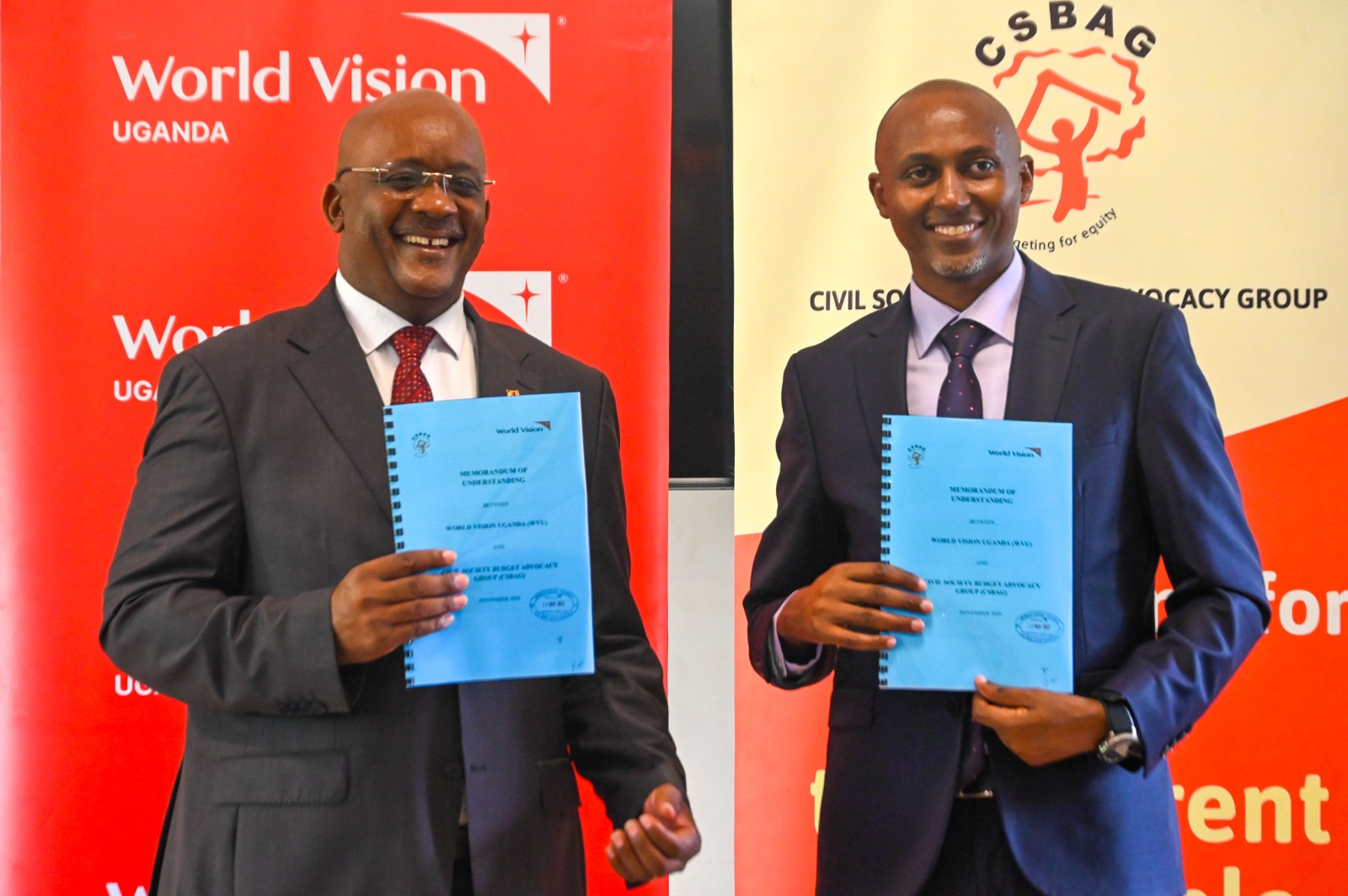
The Civil Society Budget Advocacy Group (CSBAG) and World Vision Uganda have signed a Memorandum of Understanding (MoU) at World Vision Head Offices in Kampala to push for fairer public spending, stronger accountability, and better services for communities across the country.
The partnership brings together CSBAG’s expertise in budget analysis and fiscal policy with World Vision Uganda’s four decades of experience in child well-being, community development, humanitarian support, and resilience building. Together, the two organisations aim to influence and align fiscal priorities in national budget with the daily realities of families, especially children, women, and young people.
“Economic growth must translate into better service delivery,” said Julius Mukunda, Executive Director of CSBAG. “This partnership is about making sure every shilling collected and spent improves lives, particularly for those who need it most. We call upon government to prioritise adequate and predictable financing for key social sectors, including health, education, and social protection.”
“We also urge stronger alignment between national development commitments and annual budget allocations, protection of essential social sector investments from disproportionate expenditure cuts, and public spending that responds to the actual needs of communities.”
The organisations welcomed government’s investments under the Ten-Fold Growth Strategy, National Development Plan IV, and Vision 2040, but warned that rising debt and weak budget execution are straining essential services.
Debt servicing is projected at UGX 33.6 trillion in FY2026/27, more than double the UGX 13.5 trillion planned for Human Capital Development. Uganda’s tax-to-GDP ratio of about 13.4% remains below the 15% benchmark, and fewer than 1% of climate spending is tracked under dedicated budget codes. In education, 48% of pupils still drop out before completing primary school, and 4.2 million young people are not in education, employment, or training.
“Every child deserves a future of hope, and that begins with public resources reaching every community,” said Jeremiah Nyagah, National Director of World Vision Uganda. “We believe in a God who cares for the vulnerable, and we are committed to standing with government and citizens to ensure budgets respond to their needs and protect them.”
We call for stronger alignment of budget allocations with established service delivery standards, systematic monitoring of compliance, and greater accountability, so that public financing meets the minimum requirements for quality, accessible, and equitable service delivery.”
The partners also called on government to broaden the tax base fairly, finance climate resilience before disasters strike, link funding to quality and results, and fully implement the Budget Discipline and Accountability Charter.
Under the MoU, the two organisations will conduct joint research, strengthen community-led monitoring of public investments, promote equitable resource mobilisation, and build the capacity of stakeholders in budget processes. They will engage Parliament, ministries, local governments, and development partners, and will produce citizen-friendly budget information so the public can better understand how fiscal policy decisions affect their lives.
“This is a partnership of evidence and voice,” added Jeremiah Nyagah. “Together, we will amplify what communities experience and bring it to the tables where decisions are made.”