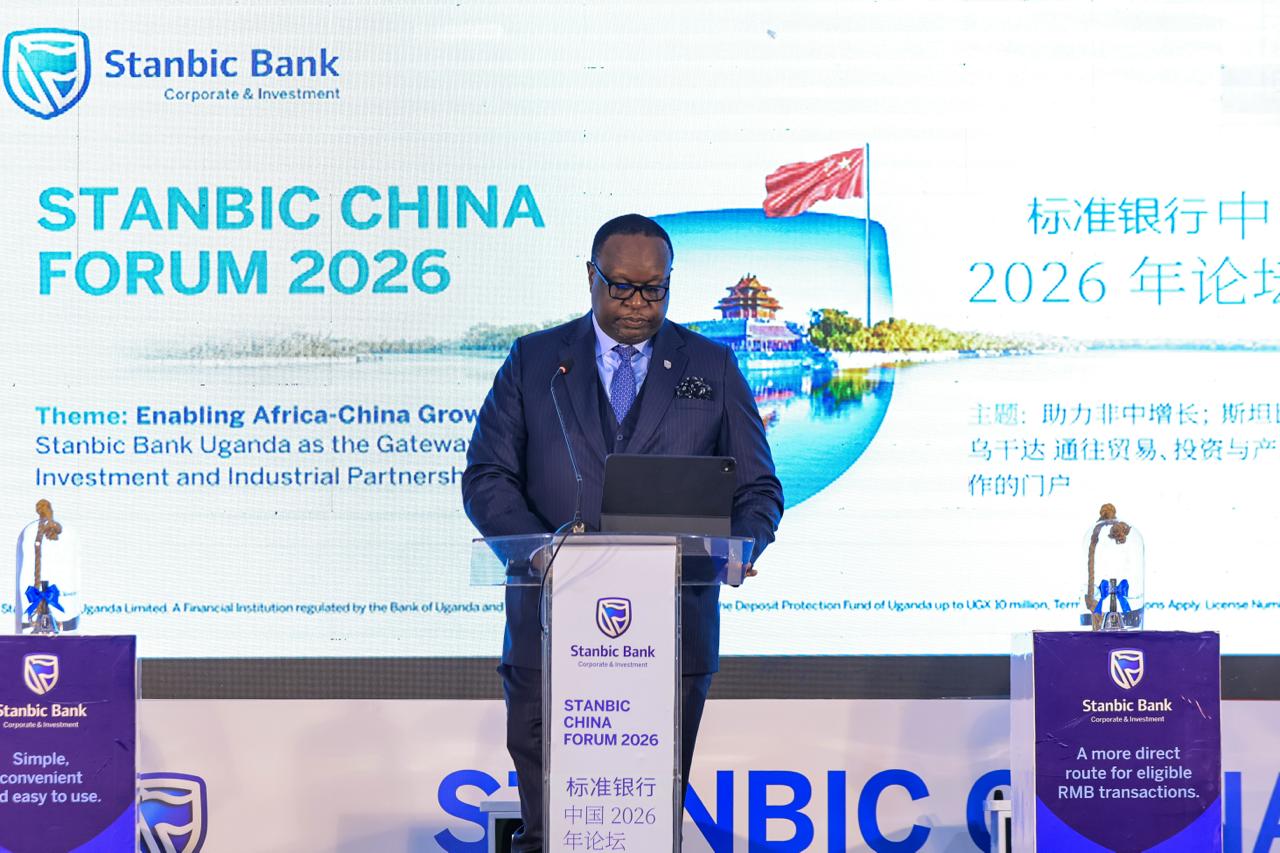
Stanbic Bank has launched access to China’s Cross-Border Interbank Payment System (CIPS), allowing Ugandan businesses to settle trade transactions directly in Chinese yuan (renminbi/RMB) and reducing reliance on the US dollar.
This development positions Stanbic, part of the Standard Bank Group, as the first financial institution in the country to offer the integration. It was unveiled at the inaugural Stanbic-China Trade Forum in Kampala.
According to a Stanbic, CIPS access, enabled via Standard Bank’s network, will make payments faster, cheaper, and more predictable. Settlement times are expected to drop from several days to just a few hours.
Businesses avoid double currency conversions, reduce foreign-exchange risk from dollar volatility, eliminate some intermediary bank fees and delays, and gain better visibility into payment status for improved cash-flow planning.
Fee details from the same reporting include outward telegraphic transfers charged the equivalent of UGX60,000 per transaction (excluding external correspondent bank fees) and inward transfers at 0.25% of the value (minimum $10, maximum $50).
Currency conversions involving the Ugandan shilling, dollar, and yuan carry a forex spread set by Stanbic’s Global Markets team based on market conditions. The bank also offers yuan-denominated accounts to help traders hedge volatility.
Stanbic CEO Mumba Kalifungwa said Chinese cumulative FDI in Uganda has surpassed $1 billion, with licensed investments around $1.2 billion, and that China ranks among Uganda’s top sources of foreign investment.
State Minister for Trade in charge of Industry David Bahati welcomed the system as a way to accelerate payments for goods and services and encouraged more Chinese industrial investment, particularly in manufacturing, industry, and oil.
Reports show that Uganda imported about $3.3 billion in goods from China in 2025 while exporting only about $118 million. Efficient yuan settlement particularly benefits importers by lowering costs and risks, while potentially helping exporters access Chinese buyers more readily.
Standard Bank Group gained authorization from China’s central bank (People’s Bank of China) earlier in 2026 to jointly clear yuan payments across 19 African countries—the first African-headquartered bank to receive such RMB clearing status.
It had joined CIPS in late 2025 and processed hundreds of millions in related transactions in early months. CIPS itself, launched by the PBoC in 2015, serves as China’s dedicated infrastructure for cross border RMB clearing and settlement (distinct from SWIFT messaging). Other African institutions, including Afreximbank, have also connected or pursued similar links.
Beijing has actively promoted yuan internationalization alongside trade measures, such as zero tariff treatment for products from many African countries. Analysts note this can reduce dollar dependence in Africa China commerce, cut conversion layers and costs, and speed settlements in markets facing hard currency constraints.
For Ugandan traders, challenges that remain include the large trade deficit, ongoing shilling volatility, the need for businesses to adapt to yuan accounts and processes, and the fact that broader correspondent banking or other currencies may still play roles depending on counterparties.